Bookmark and Share
Email get-fans-468x60

Infolinks In Text Ads

Wednesday, March 31, 2010

Pakistan to ask Switzerland to reopen Zardari cases

Pakistan's anti-corruption agency is to ask Switzerland to reopen corruption cases against President Asif Zardari.
The move came after Pakistan's Supreme Court said it would jail the head of the agency if he did not take action.
Mr Zardari and his late wife, former PM Benazir Bhutto, were convicted by a Swiss court in a $15m money-laundering case in 2003. They denied the charges.
Pakistan withdrew from the Swiss case soon after Mr Zardari's Pakistan People's Party came to power in 2008.
But an amnesty protecting Mr Zardari and other top officials from prosecution was annulled by the Supreme Court in December.
Court pressure
The court has been demanding corruption cases be reopened ever since, several of them involving President Zardari.
Before taking office, he spent years in jail after being convicted on corruption charges he says were politically motivated.
His political allies face possible prosecution in Pakistan, but he is still protected by presidential immunity.
If the Swiss authorities accede to the Pakistani request, he faces being investigated for corruption while in office.
On Tuesday Pakistan's Supreme Court threatened to jail the head of the country's anti-corruption agency unless he reopens hundreds of corruption cases.
It said the National Accountability Bureau (NAB) chairman Naveed Ahsan would be in contempt of court if he did not act within 24 hours.
"In light of directions of the court on the revival of the Swiss cases, the NAB has initiated the process," Abid Zuberi, a lawyer for the agency, told the court on Wednesday.
The Swiss Justice Ministry said it had yet to receive any request from Pakistan.
read more...

Afghanistan bombing kills 13 in busy Helmand market

A bomb explosion in a crowded village market in the south Afghan province of Helmand has killed at least 13 people and injured 45.
The attack in Babaji, near Lashkar Gah, apparently targeted farmers collecting free seeds under an anti-opium drive.
Local officials said the bomb had been strapped to a bicycle left in the market and detonated remotely.
Meanwhile, the top US military official has said the Pentagon's Afghan efforts are to focus on Kandahar.
No group said it had carried out the attack on Babaji.
The area is close to Marjah, the focus of a major offensive against the Taliban.
No foreign security forces were caught up in Wednesday's blast, the local news channel in  Kabul.
read more...

Call to bar Iraq election winners 'connected to Saddam'

Six of the winning candidates in Iraq's elections should be disqualified because of alleged ties to the former Baath government, a vetting panel says.
If upheld, the move could alter the election result, to which State of Law coalition leader, Nouri Maliki, is already mounting a legal challenge.
Former Prime Minister Ayad Allawi's Iraqiyya list won the election by two seats - too few to form a government.
A list spokesman said the suggested disqualifications would be illegal.
Unnamed officials from the Justice and Accountability Committee told the Associated Press (AP) news agency four of the six candidates belonged to Mr Allawi's Iraqiyya list, but none of the six was named.
The committee was set up to prevent people connected to Saddam Hussein's ruling Baath party from standing for elected office.

Officials said they had submitted 52 names before the election calling for them to be barred from standing, but the Independent High Election Commission did not act on the committee's recommendation and six of those candidates won their elections.
The other two are a Kurdish candidate and a member of the State of Law coalition, AP reported.
Iraqiyya list member Hamid al-Mutlaq said: "The decisions of the Accountability and Justice Committee are not legal, those six winning candidates have the approval of the election commission.
"This is a political decision, not a legal one."
About 500 candidates were barred from standing before the election by the commission.
On Monday Mr Allawi accused Iran of trying to prevent him from becoming prime minister.
Both the UN and US envoys to Iraq have said the 7 March poll was credible.
Much of Mr Allawi's support came from Iraq's Sunni minority, says the a news channel in Baghdad, but most of the parties he would need to back him represent Iraq's Shia majority and have close ties to Iran.
read more...

Twelve killed by twin bombings in Russia's Dagestan

At least 12 people, including a top local police official, have been killed by two suicide bombings in Russia's North Caucasus republic of Dagestan.
A car bomb was detonated at about 0830 (0430 GMT) outside the offices of the local interior ministry and the FSB security agency in the town of Kizlyar.
Another bomber then blew himself up 20 minutes later as a crowd gathered.
Russia is on alert after double suicide bombings on the Moscow Metro on Monday morning, which left 39 people dead.

Prime Minister Vladimir Putin has called on the security forces to "scrape from the sewers" those responsible for the Moscow attacks. Investigators say they believe the bombers were linked to militants in the North Caucasus.
At a government meeting following Wednesday's bombings in Dagestan, Mr Putin condemned the "terrorist act" and said he did "not rule out that it is one and the same gang at work".
President Dmitry Medvedev said the two sets of bombings were "links of the same chain".
A militant Islamist group led by a Chechen rebel on Wednesday denied responsibility for the blasts.
"We did not carry out the attack in Moscow, and we don't know who did it," Shemsettin Batukaev, a spokesman for the Caucasus Emirate organisation led by Doku Umarov, told Reuters by telephone in Turkey.
The spokesman added that the group had planned attacks on economic targets inside Russia, but not against civilians.
Last month, Doku Umarov warned that his fighters' "zone of military operations will be extended to the territory of Russia... the war is coming to their cities".

A local news channel in Moscow says that although no-one has yet claimed responsibility for either of this week's attacks, both bear the hallmarks of previous suicide bombings carried out by Islamist militants from the North Caucasus.
read more...

Poor weather halts search of South Korea sunken warship

South Korean search teams have suspended their efforts to reach missing sailors on a sunken warship because of poor weather conditions.
The move comes a day after a diver died searching the wreckage of the Cheonan, which is lying near Baengnyeong Island, close to the border with North Korea.
Forty-six sailors have been missing since an explosion split the ship in two late on Friday.
A minister said the blast could have been caused by a North Korean mine.
A defence ministry spokesman in Seoul told the Yonhap news agency that waves at the rescue site were up to 2m (6ft) high, with winds blowing at 10 knots.
"We are temporarily suspending operations. We cannot expect to get near the ship in this condition," said Won Tae-Jae.
The diver who died, one of dozens trying to gain access to the wreckage, reportedly lost consciousness under water. Yonhap said two of the others were in hospital.
On Tuesday, a navy spokesman said the divers were working in "a very vicious environment" with swift currents and poor visibility.
"Our goal is to get into the ship and find any survivors, but at the moment it is extremely hard to do so," he said.
read more...

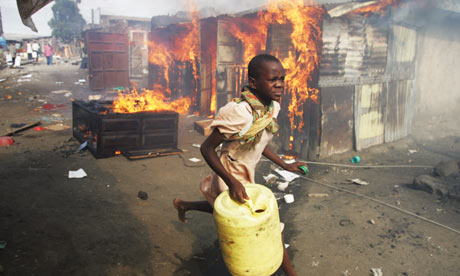
ICC to investigate Kenya 2007 election violence

The International Criminal Court has authorised its prosecutor to investigate the violence that followed Kenya's 2007 election.
Some 1,300 people died and tens of thousands were displaced as political differences snowballed into weeks of ethnic score-settling after the poll.
ICC Prosecutor Luis Moreno-Ocampo asked judges last November to approve an investigation into the violence.
He has said Kenyan political leaders organised and financed some violence.
The ICC authorised the investigation in a majority ruling on Wednesday.
"The information available provides a reasonable basis to believe that crimes against humanity have been committed on Kenyan territory," said the court.
Aid groups and Western governments have urged Kenya to introduce electoral reform, eradicate corruption and punish those who led the killing.
Many Kenyans will welcome this decision as it is widely felt that unless some people are punished for the post election violence of two years ago, the events could all too easily be repeated, says the local channel.
So far nobody has been held to account for the events which took Kenya to the brink of civil war.
But now cabinet ministers and other powerful Kenyans look set to appear in the dock before ICC judges, our correspondent adds.
read more...

UN chief Ban Ki-moon urges support for $4bn Haiti plan

UN chief Ban Ki-moon has opened a fundraising conference on Haiti by calling for a "wholesale national renewal" of the earthquake-hit country.
Mr Ban gave his support to a plan to rebuild Haiti which will require almost $4bn (£2.65bn) in initial aid payments.
US Secretary of State Hillary Clinton told delegates the US would give $1.15bn. Other nations are expected to make up the rest.
The 12 January earthquake killed 200,000 and left one million homeless.
The Haitian government and international officials have spent weeks putting together a plan for the country.
They intend to set up a trust fund to decide how to spend the aid money, and will establish a commission to oversee reconstruction work.
The main tasks are to rebuild destroyed government buildings, hospitals and schools, get farms working again and create jobs.
Mr Ban, the UN secretary general, described the plan as "concrete, specific and ambitious", and said delegates should give it their "full and generous support".
read more...

Monday, March 29, 2010

Citigroup: US to sell its stake in bailed-out bank

The US government is preparing to sell its 27% stake in Citigroup, in what would be one of the largest share sales in history.
Some 7.7 billion shares in the bailed-out bank will be sold in tranches throughout 2010, the US Treasury said.
It will mark another stage in Wall Street's recovery, and could make the US taxpayer $8bn (£5.3bn) in profit.
Citigroup, which has posted more than $100bn in write-downs, required three government rescues in 2008 and 2009.
At Citigroup's opening share price of $4.39 on Monday, the Treasury's stake would be worth just over $33bn, giving an $8bn profit to the US taxpayer.

The bank has received a total of $45bn in bail-out money from the Treasury's $700bn Troubled Asset Relief Program (Tarp). It was the largest amount given to a bank (and was equal to the sum given to Bank of America).
Citigroup was given $25bn in return for 7.7 billion in shares, and was loaned another $20bn in two tranches. This $20bn was repaid in December.
The bank, once one of America's most illustrious financial institutions, has seen its share price collapse 90% since late 2006 as fears about its financial health grew.
Its shares fell after the Treasury confirmed the sale, falling 4% to $4.11. Before the credit crisis they were worth more than $50.
Morgan Stanley has been chosen to underwrite and advise on the sale, though the US Treasury emphasised that the disposal was subject to market conditions.
A Treasury statement said that it "intends to sell its Citigroup common shares into the market through various means in an orderly and measured fashion".
It is thought that the share sales will begin after Citigroup reports its results next month.
Citi follows other Wall Street banks, including Goldman Sachs and Bank of America, who have repaid the government investment.
Although the bank rescues now seem likely to be profitable, other financial aid will probably cost the taxpayer money, including the insurer AIG and the carmakers General Motors and Chrysler.
According to the latest official report on the state of Tarp at the end of 2009, 67 recipients had repaid all or part of their bail-out money, totalling more than $165.2bn.
The Treasury had also received by the end of December $16.9bn in additional payments such as interest and dividends on its investments.
read more...

Gaddafi says Nigeria should split into several states

Libya's leader Muammar Gaddafi says Nigeria should become several states, despite Nigerian fury after he earlier said it should become two countries.
He said he was wrong to have said earlier this month that Nigeria should be divided into Muslim and Christian areas to end communal clashes.
Instead, he now says several different Nigerian groups want independence.
Nigeria recalled its ambassador to Tripoli after his previous statement, which it branded "irresponsible".
'Mad man'
"His theatrics and grandstanding at every auspicious occasion have become too numerous to recount," said a foreign ministry statement.
A Nigerian senator called Col Gaddafi, until recently head of the African Union, a "mad man".
The Loc in Tripoli says the dispute appears to have become a tit-for-tat game.
Col Gaddafi initially suggested the split to prevent any more bloodshed between rival groups in central Nigeria.
Hundreds have died this year in ethnic and religious violence around Jos.
Nigeria is Africa's most populous nation, with some 130 million people, and has more than 250 different ethnic groups, broadly divided into a largely Muslim north and mainly Christian south.
Yugoslav example
"It became clear... that Nigeria does not consist of two parts," Col Gaddafi said in a statement.
"The Yoruba people in the west and south demand independence, while the Igbo people live in the east and south.
"It became clear that the Ijaw people demand independence and the [Hausa] people in the north call for the establishment of the [Hausa] state."
In his original comments, Col Gaddafi said that Nigeria should be divided - comparing it to the partition of British India into Hindu-dominated India and Muslim Pakistan, which led to at least 200,000 deaths and possibly as many as one million.
But the Libyan leader now suggests Nigeria should follow in the footsteps of Yugoslavia.
He says the most bloody conflict in the former-Yugoslavia - in Bosnia - arose because that was a multi-ethnic state, while the other countries seceded "peacefully".
An attempt by Nigeria's Igbo people to gain independence in 1967 sparked a war which left more than one million people dead.
read more...

Moscow Metro hit by deadly suicide bombings

At least 38 people have been killed after two female suicide bombers blew themselves up on Moscow Metro trains in the morning rush hour, officials say.
Twenty-four died in the first blast at 0756 (0356 GMT) as a train stood at the central Lubyanka station, beneath the offices of the FSB intelligence agency.
About 40 minutes later, a second explosion ripped through a train at Park Kultury, leaving another 14 dead.
The FSB said it was likely a group from the North Caucasus was responsible.
A news channel in Moscow says no group has yet said it carried out the attacks, but past suicide bombings in the capital have been carried out by or blamed on Islamist rebels fighting for independence in Chechnya.
In February, Chechen rebel leader Doku Umarov said "the zone of military operations will be extended to the territory of Russia... the war is coming to their cities".
At an emergency meeting with senior officials, President Dmitry Medvedev vowed to uphold the "policy of suppressing terror and the fight against terrorism".
"We will continue operations against terrorists without compromises and to the end," he said.
Federal security forces have scored a series of successes against militants in the North Caucasus in recent weeks. In February, at least 20 insurgents were killed in an operation by troops in Ingushetia.
read more...